A working paperVersion 2.1August 2026
What if the problem is the container?
Space Immanence argues that consciousness and spacetime pose two versions of one problem: we assume that everything must exist inside something.
Its speculative wager: world and awareness are two appearances of one self-referential structure. A philosophical proposal, not a proof.
The proposal
A shared assumption.
Both questions may assume that everything must exist inside something.
Containment helps describe relations between things, but it breaks down when applied to experience or the universe as a whole. On this proposal, that breakdown produces two familiar problems: how consciousness arises in matter, and how spacetime arises from something non-spatial. Asking where consciousness is in the brain, or what spacetime emerges into, already assumes a container.
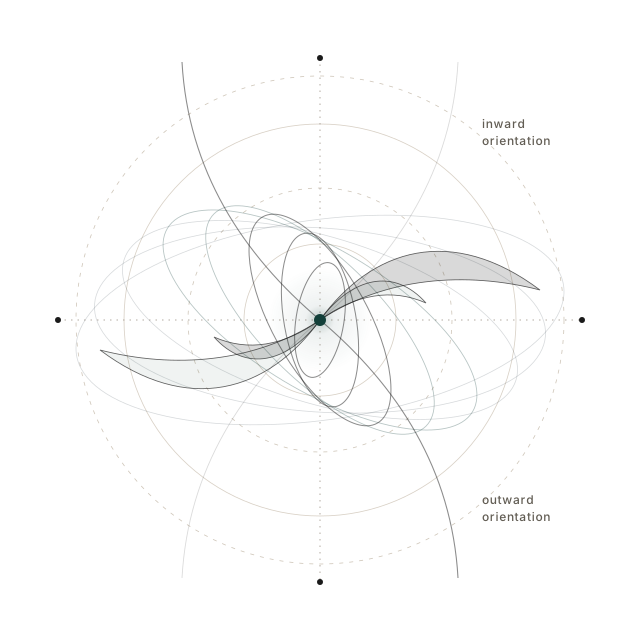
The speculative wager is that these two problems share one cause. The proposed alternative is the fold: a structure that takes its own operations as content. World is the fold facing outward; awareness is the same structure facing inward. This is a proposal in speculative metaphysics, not a proof. The claims ledger grades its claims by confidence and states where each could fail.
Container logic
Fold logic
One structure seen from two sides; neither side produces the other.
01 / The proposed structure
The fold
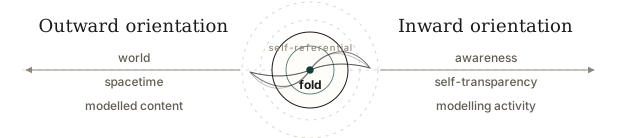
A fold is the name given here to a system that represents relations within itself, including its own activity.
The fold describes recursion, where a process takes its own operation as content; it is not a spatial object. In folds meeting four structural criteria, that recursion has two primitive orientations that cannot be reduced to one another.
You can attend both to what you are aware of, such as these words or a sound, and to the fact of being aware. The fold is the claim that these are one self-referential structure seen in two ways: world facing outward, awareness facing inward.
02 / Change over time
How patterns change: cohering
Cohering describes how a temporary pattern of experience holds together: a sense of self, a perceived world, or the meaning of a sentence. Each depends on conditions that can change. The term replaced “resolution” in v2.0 after readers found that the old name suggested a final outcome or a hidden cause.
Cohering describes how a structure becomes a lived moment. Its claims are graded by confidence. It is a process, never a substance, a new force, or a goal for the universe.
A coherence-event
A description of changing patterns, with no intended final state.
03 / Strength of the claims
Published claim ratings
The paper grades each claim by confidence. Readers who reject the speculative claims can test whether the strong claims survive that rejection. Each claim names its falsifier, the condition under which it weakens, and the nearest earlier account in the literature. Author-assigned confidence numbers live in claims.json and nowhere else.
Strong claims
Claims about the container assumption, the study of structure, and reports of contemplative experience as data.
Built on the fold (speculative since v2.5)
The proposal that self-reference connects the appearance of a world with awareness, and the claims that rest on it. Medium until 11 October 2026.
Speculative claims
Spacetime as self-reference cohering from within into something inhabitable. Locality and duration describe how relations hold together for the fold, not a static identity. Open to objection 17.
04 / Open questions
Where the proposal may fail
Two unresolved questions are central to the argument.
Why would self-reference feel like anything?
Does representing one’s own activity involve experience, or can it occur without any experience?
How widely does the account apply?
Do two orientations reliably describe human reports, and do they extend beyond them?
Research & evidence
What can be tested?
Published findings · corrected record
First data: agreement and accuracy
In the Swarm Instrument’s pre-registered first study, three identical agents became more confident after one round of debate without becoming more accurate. Before debate, their answers were nearly calibrated: confidence was close to accuracy. After debate, collective overconfidence rose while accuracy drifted down.
The pilot developed into the pre-registered programme (Studies 1–3). A results ledger tracks every committed prediction, including the seven that came back null. The first headline was corrected in public after the logs revealed a measurement artifact. These studies test how AI agreement relates to accuracy; they provide no evidence for the metaphysical claims.
Study 1: the same three agents (pilot, corrected)
The data, pre-registration, null results, and correction are available.
Public pilot · programme v0.2
The container programme
The Container Problem (programme v0.2, public-pilot) asks whether reports of a “space of awareness” have a measurable common factor, and whether conditional remainder-modelling can derive it: a model of awareness as what remains outside represented content, under specified conditions. The programme was reviewed critically before publication; the full review corpus is available. It has eight pre-committed falsification conditions, specifying findings that would require abandoning a claim, and a machine-readable record. Results can count against the metaphysics but can never confirm it. The firewall blocks credit in both the naive direction and the flattering one, and permits discredit to flow.
Applications
Systems, experience, and design.
Comparing different kinds of system
The Aperture Framework compares what systems can know, how they change through interaction, and whether they might have experience. It calls these the epistemic, relational, and phenomenal aspects of an aperture. A language model can help someone learn or think differently without that showing that the model itself has experience.
Helping users make choices
An AI product can predict what a person will click. It can also help that person understand what they want and make a considered choice. The design proposal asks how to measure and support the second aim.